
How to Install B&B Trees
You’ve just purchased or are considering purchasing a tree that was balled in burlap. Now you have to ask yourself, how do I properly install a B&B tree? It may be intimidating to some who are used to plastic pots or smaller perennials, but there are many benefits to installing a B&B tree. B&B trees have a much higher transplant success rate than potted trees, the burlap they’re grown in prevents the roots from spiraling and becoming root bound prior to installation, and there is typically less (not zero) watering needed to establish.
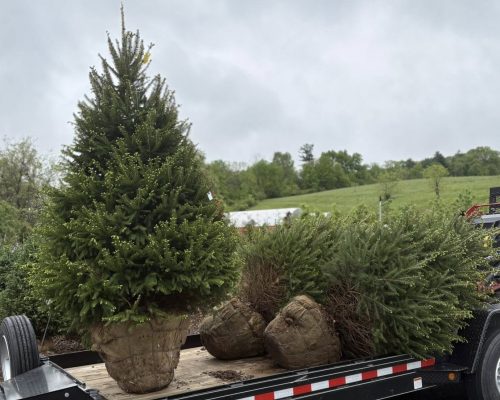
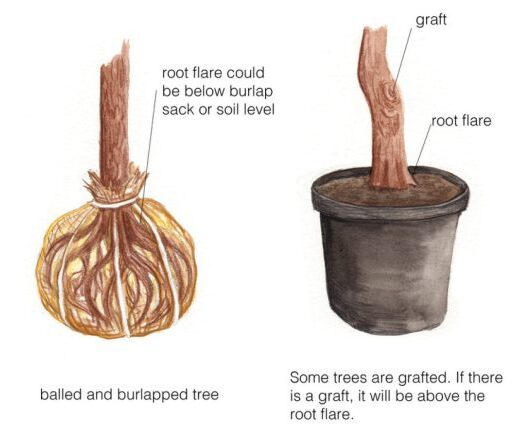
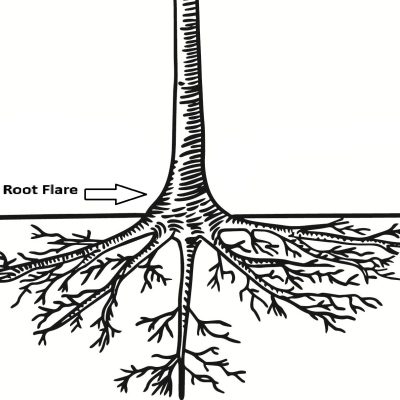
The first step involved with planting a B&B tree is digging the hole. A properly dug hole will be 2-3 times as wide as the root ball, and about 2-3 inches less deep than the height of the burlap. If the root ball is 16″ high, the hole should be dug 13-14″ deep. You do not want to dig your hole too deep. It’s important that once the tree is planted, the root flare is exposed and not buried. Very often, the root flare will be below the burlap, which is why we don’t dig the full depth. Improper planting depth can lead to the crown failing over time.
Flare high, tree doesn't die!
Flare low, tree doesn't grow!
We recommend using BioTone starter fertilizer. The mycorrhizae fungi bond with the roots and aid with the transplant process. BioTone should be spread around the bottom of the hole evenly, so the burlap makes contact with it.
Once you have your hole dug to the proper depth and width, and you’ve added BioTone starter fertilizer to the hole, then you can place the tree in the hole. If you need to adjust the height, now is the time.
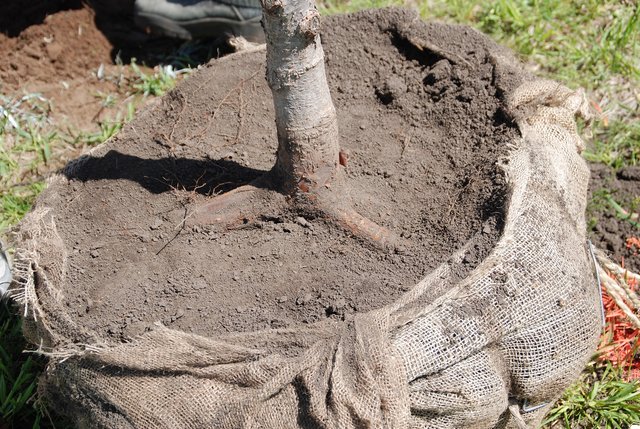
You then should assess your tree. Large trees will come with a metal cage; you can leave this on. There is usually rope or twine wrapped around the metal cage, or sometimes even the whole ball. This rope or twine should be removed entirely. Once you have removed any roping, you can then pull the burlap away from the top of the ball to reveal the trunk and root flare. Pull the burlap until you can start to see the sides of the ball exposed. Then, cut off the excess burlap that you pulled away.
After removing the burlap from the top side of the ball, you should then reveal the root flare if it is not already exposed. You should prune any roots that point upwards. At this point, the tree is properly prepared to be planted.
Once the tree has been prepared, and you’ve determined that it is at the correct depth, you can begin to backfill. When backfilling, it is best to use some of your native soil. Using Coast of Maine organic planting mix or compost to amend your soil is a great way to get robust growth out of your tree. Using a 50/50 mix of your native soil and an organic compost or planting mix is the go-to blend for healthy root growth. Make sure that the soil is compact enough so that it has no air holes underground, but not too tight that it restricts water from flowing. If you are unsure how tight the soil is, water the tree in before you pack to tight. After the water settles, you’ll be able to see any areas where the soil is not tight enough.
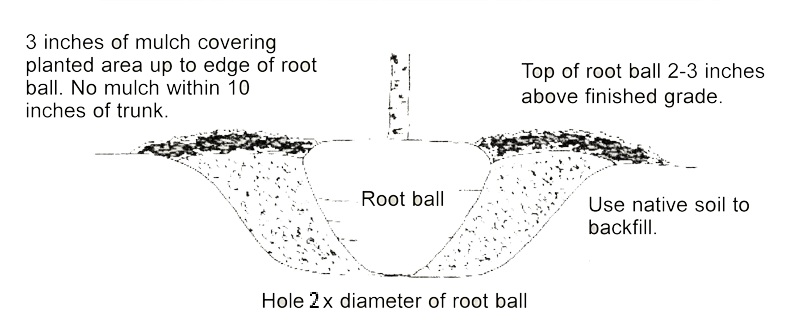
2-3 inches of mulch will help to protect the soil and retain moisture. Do not mulch directly over the root flare. Water deeply and slowly to ensure the entire root ball and surrounding soil is saturated. Be sure to water the tree as needed throughout the first year. Water more if planting in Summer. Staking may be needed if planting in a windy location, on a hill, or if the tree is too top heavy for the size of the ball. If you need to stake, keep the stake away from the trunk and outside the initial root ball. If you follow all these steps, then your tree will have the best possible chance to thrive!